Official Website


The Lords of Wisdom
SEASON 1 - EPISODE 3 - AUCTORITAS
PRODUCER
Jose Manuel Medina
RELEASED
Expected 2027
RECORDED
Moonrider Studios
Spain
ARTWORK
James Lobaco
AUCTORITAS
1. The Three Estates and The Feudal Blueprint
In the medieval worldview, society was not viewed as a collection of equal individuals, but as a divinely ordained, organic hierarchy designed to mirror the harmony of heaven. This structure was fundamentally anchored in the doctrine of the Three Estates (Tres Ordines): those who fight (bellatores), those who pray (oratores), and those who work (laboratores).
At the absolute heart of this social organization lay feudalism, an intricate web of reciprocal obligations, oaths of loyalty, and land distribution. Power and wealth were measured almost entirely by control over land (fiefs), which monarchs granted to powerful lords in exchange for military service and counsel. Down the chain, lords sub-infeudated their lands to lesser knights and vassals.
This land distribution created stark disparities in agricultural scale and economic power:
-
Latifundia: Vast, sprawling estates controlled by the high nobility, monastic orders, or royal prerogatives, worked by dependent peasants and managed with centralized feudal authority.
-
Smallholder Plots (Minifundia): Fragmented, modest patches of land farmed by independent or semi-free peasants who struggled to survive seasonal hardships, taxes, and the ever-present threat of crop failure.
2. The Pyramid of Power: The Nobility and The Church
While the King sat at the apex of the secular realm as the supreme sovereign, the nobility itself was intensely stratified, dictated by bloodlines, titles, and military might:
-
The High Nobility: Dukes, counts, and high-ranking barons who ruled vast territories, commanded private armies, and possessed immense political clout capable of challenging even the crown.
-
The Lesser Nobility: Local lords, hidalgos, and knights who held smaller manors (solariego), often living modest lives tied closely to the defense of local borders and the administration of village justice.
Parallel to the nobility stood the Church, which wielded immense spiritual and temporal authority (Auctoritas). Here too, a rigid hierarchy prevailed:
-
The Upper Clergy: Bishops, abbots, and cardinals came almost exclusively from noble families, controlling vast wealth, tithes, and immense tracts of monastic land.
-
The Lower Clergy: Parish priests, impoverished monks, and friars who lived among the common people, often sharing their daily struggles, superstitions, and poverty while providing vital spiritual solace.
3. The Common Folk: Serfs, Freemen and Rural Representation
At the base of the medieval pyramid sat the laboratores—the vast majority of the population whose sweat and toil sustained the entire social edifice. Yet even the common folk were sharply divided by legal status and geography:
-
Serfs (Servi): Bound directly to the soil, serfs were legally tied to the lord's manorial estate. They could not leave, marry, or change professions without the lord's explicit consent, rendering them subject to arbitrary labor duties (corvées) and heavy dues.
-
Free Peasants and Burghers: Unlike serfs, independent freemen owned or rented small parcels of land with greater autonomy. Over time, as trade revived and towns (burgos) grew, certain rural communities and urban centers gained local charters (fueros).
-
Local Representatives: Even within the peasant class, a distinct social stratification existed. Wealthier peasant elders, village mayors, and guild or community representatives held considerable local importance, acting as intermediaries between the lordly bailiffs and the working populace to negotiate taxes, manage communal lands, and uphold customary village law.
The Lords of Wisdom — Season 1: Episode 3 AUCTORITAS
A Seamless continuation of an epic saga
Musically, the second part of Reconquista remains entirely faithful to the path forged by its predecessor. In truth, this release must be understood not as a standalone venture, but as a single, massive continuous chapter that—due to its sprawling duration and the strict physical constraints of the compact disc format—had to be divided into two halves. Spanning nearly eight centuries of history, the album offers a condensed yet deeply evocative musical canvas, painting in sound the distinct realms and cultural clashes that shaped the medieval Iberian Peninsula.
True to the structure of the first volume, the album comprises 15 tracks, featuring brilliant multi-instrumentalist master Rafael Pacha as he once again unleashes his breathtaking virtuosity across an astonishing array of string, wind, and keyboard instruments. This second installment also places a richer, more profound emphasis on romantic, Andalusian melodies reflecting the golden age and splendor of Al-Andalus. Notably, the principal leitmotif of this southern heritage was already introduced in The Grand Overture of the previous installment, creating a cohesive, cyclical narrative thread.
New Virtuosos and Majestic Highlights
While maintaining the core artistic vision, this second chapter welcomes talented new contributors to the roster, most notably the exquisite, haunting vocals of Lisa Fury and the exceptional interpretive mastery of keyboardist and composer Alessandro di Benedetti, whose artistic touch deepens the progressive and cinematic textures of the record.
Among the 15 tracks, two towering pieces anchor the listening experience:
-
"Reconquista": The magnum opus and title track of the episode. Clocking in at over 16 minutes, this monumental progressive rock suite takes the listener on a breathtaking journey through eight centuries of conflict, shifting alliances, and territorial evolution.
-
"Portugal": Another standout masterpiece, highlighted by an imposing, emotionally charged vocal performance delivered by Mariano Gardella.
True to the signature style of the project, the album is crowned by powerful orchestral arrangements performed by the Somnus Symphony Orchestra & Choir, effortlessly alternating between thunderous martial energy and serene, contemplative passages that invite the listener to dream of the legendary landscapes of medieval Spain.
TRACKS
01. OUTREMER: THE OTHER SHORE (3:46)
02. SALADIN (18:30)
03. JOURNEY TO THE HOLY LAND (7:12)
04. FACES ON THE WIND (4:29)
05. THE LEPER KING (X:XX)
FEATURING MARIANO GARDELLA
06. CONFRONTATION (4:45)
07. LION & CRESCENT (4:40)
FEATURING MARIANO GARDELLA & JOSE MANUEL MEDINA
08. THE SOUTHERN CROSS (3:55)
FEATURING LISA FURY & MARC ATKINSON
09. OUTREMER: THE CONQUEST (4:13)
10. SADNESS (2:57)
FEATURING LISA FURY
11. KEEPER OF THE HOLY GRAVE (9:30)
12. CONFRONTATION REPRISE (1:00)
FEATURING JOSE MANUEL MEDINA
13. CHIVALRY TALES IV (2:00)
14. CHIVALRY TALES V (1:30)
15. CRUSADES (18:00)
FEATURING MARIANO GARDELLA
MUSICIANS
THE LORDS OF WISDOM 1 - EPISODE 2 - CRUSADES PART 1: CRUSADES
Behind this continuation of the epic sonic journey stands an extraordinary roster of international talent and virtuoso musicians, where master multi-instrumentalist artistry blends with new creative voices. From intricate acoustic and wind textures and haunting vocal performances to soaring progressive keyboards, thunderous basslines, and cinematic choral arrangements, discover the brilliant minds and performers who shaped The Lords of Wisdom - Season 1: Episode 2 (Reconquista, Part 2: The Fall of Al-Andalus):

Rafael Pacha
The Guildmaster | The Samurai of Prog
Spain
Performance
Acoustic Guitars, Electric Guitars, Classical Guitars, Mandolin, Violin,
Viola da Gamba, Bowed Psaltery,
Bass, Dadgad, Recorders, Flutes, Zither & Hurdy-Gurdy


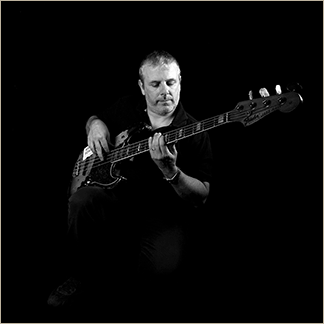
Pablo Lato
Funes | Enfadados
Argentina/Spain
Performance
Electric Bass

Mariano Gardella
Product Manager
Argentina
Performance
Main & Backing Vocals


Deibys Artigas
Claxxon
Venezuela
Performance
Main & Backing Vocals
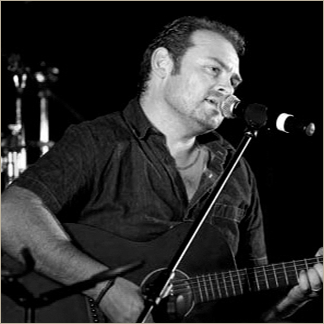
Marc Atkinson
Riversea | Moonhalo | Mandalaband
United Kingdom
Performance
Main & Backing Vocals

Nelson Pombal
Funes
Argentina
Performance
Electric Guitars

Lisa Fury
Karnataka | Fleetwood Bac
United Kingdom
Performance
Main & Backing Vocals

Alessandro di Benedetti
Mad Crayon | Inner Prospekt
Italy
Performance
Main & Backing Vocals, Vocoder

Jeff Duncan
Tempest Stone Fable
United States
Performance
Drums

Roberto Gómez
Pulsar to Floyd
Spain
Performance
Electric Guitars

Luis Vilca
Perú
Performance
Concert Flute

Jose Manuel Medina
Mandalaband
Spain
Performance
Piano, Synths, Hammond B3, Rhodes, Vibraphone, Mellotron, Harpsichord, Bass, Electric Guitars & Percussion.
Where to find this album


